🐦प्यासा कौआ की कहानी

🌟 परिचय
प्यासा कौआ की कहानी बच्चों की सबसे लोकप्रिय और सीख देने वाली कहानियों में से एक है।
यह कहानी हमें समझदारी (Intelligence), धैर्य (Patience) और समस्या का हल (Problem Solving) सिखाती है।
👉 यह कहानी खास तौर पर
- बच्चों 👶
- छात्रों 📚
- और नैतिक शिक्षा के लिए बहुत उपयोगी है
📖प्यासा कौआ की पूरी कहानी

एक समय की बात है, एक कौआ 🐦 बहुत प्यासा था।
गर्मी का मौसम था ☀️ और तेज धूप पड़ रही थी।
कौआ आसमान में उड़ता हुआ हर जगह पानी ढूंढ रहा था।
लेकिन… 😟
उसे कहीं भी पानी नहीं मिल रहा था।
काफी देर तक खोजने के बाद, उसे एक घड़ा (मटका) 🏺 दिखाई दिया।
कौआ तुरंत नीचे आया और घड़े के अंदर झांककर देखा।
👉 घड़े में थोड़ा सा पानी था,
लेकिन पानी बहुत नीचे था।

कौए ने अपनी चोंच अंदर डालकर पानी पीने की कोशिश की,
पर उसकी चोंच पानी तक नहीं पहुंच सकी।
अब कौआ सोच में पड़ गया 🤔

💡 “मैं इस पानी को कैसे पी सकता हूँ?”
कुछ देर सोचने के बाद, उसे एक शानदार विचार आया।
उसने आसपास छोटे-छोटे कंकड़ (पत्थर) देखे।

👉 कौआ एक-एक करके कंकड़ उठाता
और घड़े में डालने लगा।
धीरे-धीरे…
घड़े का पानी ऊपर आने लगा 💧⬆️
कौआ लगातार कंकड़ डालता रहा।

कुछ समय बाद, पानी इतना ऊपर आ गया
कि अब वह आसानी से पानी पी सकता था 😊
👉 कौए ने खुशी-खुशी पानी पिया
और अपनी प्यास बुझाई 🐦💧
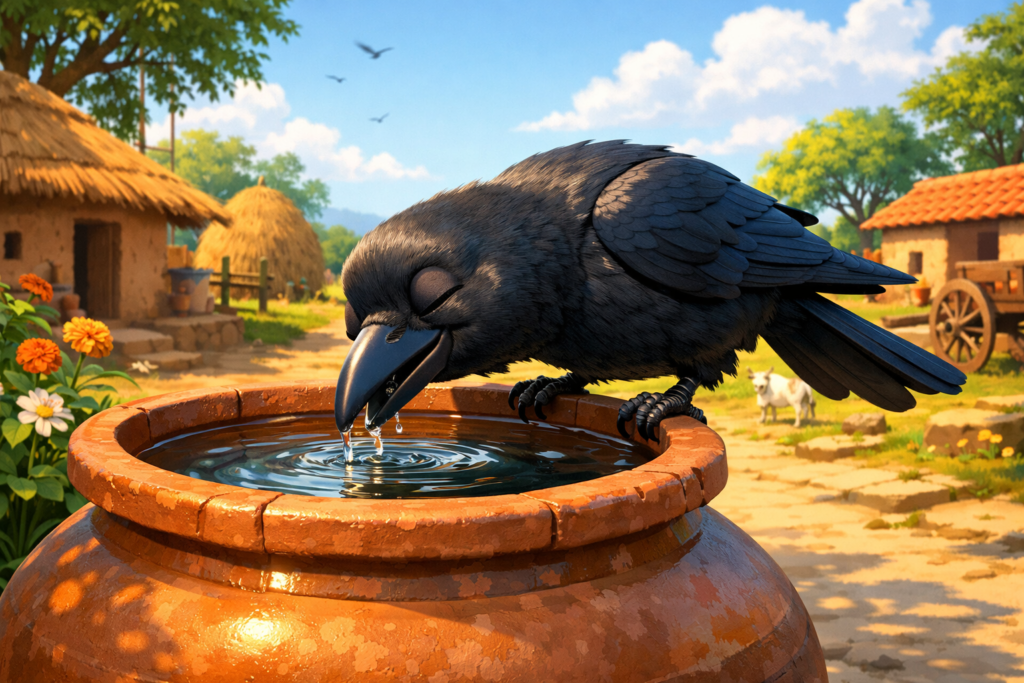
फिर वह उड़ गया।

🧠 कहानी से सीख (Moral of the Story)
👉 “जहाँ चाह होती है, वहाँ राह मिलती है।”
👉 “समझदारी और धैर्य से हर समस्या का हल निकाला जा सकता है।”
Water Level Calculator
Inspired by the Wise Crow Story – Calculate how stones raise water level
Enter Values
Total height of the pot/container
Current water level before adding stones
Each stone displaces 0.5 units of water
Live Visualization
What is a Water Level Calculator?
A Water Level Calculator is an innovative online tool designed to help users understand and predict how water levels change when objects are added to a container. This calculator is inspired by the famous Aesop’s fable of the Wise Crow, where a clever crow drops stones into a pitcher to raise the water level and drink. Our tool applies real physics principles to calculate water displacement accurately, making it both educational and practical for students, educators, engineers, and curious minds.
The calculator takes into account the container dimensions, initial water level, and the number of stones or objects being added. Using the principle of water displacement, it determines the final water level and whether the water becomes reachable. This tool bridges the gap between theoretical physics concepts and practical applications.
How Does the Water Level Calculator Work?
Our Water Level Calculator operates on a straightforward yet scientifically accurate principle. When you drop stones into a container filled with water, each stone occupies space that was previously held by water. Since water cannot be compressed, it rises to accommodate the displaced volume. This phenomenon is known as water displacement, a concept discovered by the ancient Greek mathematician Archimedes.
The calculator requires three simple inputs: the pot height, the initial water level, and the number of stones. Each stone in our simulation displaces a fixed amount of water (0.5 units), representing a realistic approximation of small pebbles. The tool then calculates the total displacement and determines the new water level instantly.
The Water Level Formula Explained
Final Water Level = Initial Water Level + (Number of Stones x Displacement per Stone)
This formula is derived from the fundamental principle of volume conservation. Let’s break it down step by step: The Initial Water Level represents how much water is already in the container. The Number of Stones tells us how many objects will be added. The Displacement per Stone is the volume of water each stone pushes upward.
For example, if you have a pot with 5 units of water and add 20 stones (each displacing 0.5 units), the calculation would be: 5 + (20 x 0.5) = 15 units. The water rises from 5 to 15 units, a significant increase of 10 units. This simple calculation demonstrates the power of cumulative displacement.
The Wise Crow Story: A Timeless Lesson
The story of the Wise Crow originates from Aesop’s Fables, a collection of moral stories from ancient Greece. In this tale, a thirsty crow discovers a pitcher with a small amount of water at the bottom. The crow cannot reach the water with its beak, no matter how hard it tries. Instead of giving up, the clever bird begins dropping small pebbles into the pitcher one by one.
With each stone dropped, the water level rises slightly. After many stones, the water finally reaches the top of the pitcher, allowing the crow to drink. This story teaches us about persistence, problem-solving, and the practical application of physics. Our Water Level Calculator brings this ancient wisdom to life, allowing you to experiment with different scenarios and see the results instantly.
Practical Use Cases for Water Level Calculations
While the Wise Crow story provides an engaging context, water level calculations have numerous real-world applications. Civil engineers use similar principles when designing dams, reservoirs, and drainage systems. Naval architects calculate water displacement to determine ship buoyancy and cargo capacity. Environmental scientists model water levels in lakes and rivers to predict flood risks.
In education, this tool helps students visualize and understand displacement physics. Teachers can demonstrate how volume and density affect water levels. Students can experiment with different variables and observe cause-and-effect relationships. The interactive visualization makes abstract concepts concrete and memorable.
Tips for Accurate Water Level Calculations
- Always measure your container dimensions accurately. Small errors in initial measurements can lead to significant calculation discrepancies.
- Consider the shape of objects being added. Irregular stones displace water differently than uniform spheres. Our calculator uses a standardized displacement value for consistency.
- Account for overflow scenarios. If the final water level exceeds container capacity, water will spill out. Our tool alerts you when overflow occurs.
- Use consistent units throughout your calculations. Mixing different unit systems can cause errors. Stick to one measurement system for all inputs.
Frequently Asked Questions
Our calculator uses mathematically precise formulas based on water displacement physics. The accuracy depends on the input values you provide. For educational purposes and general estimations, the results are highly reliable. Real-world applications may require additional factors like temperature and container irregularities.
Water displacement occurs when an object is submerged in water, causing the water level to rise. The amount of rise equals the volume of the submerged object. This principle was famously discovered by Archimedes and is fundamental to understanding buoyancy and fluid mechanics.
This calculator is designed primarily for educational purposes and conceptual understanding. While the physics principles are accurate, professional engineering projects require more sophisticated tools that account for additional variables like material properties, environmental conditions, and safety factors.
We chose 0.5 units as a representative value for small pebbles similar to those a crow might carry. This allows for clear demonstration of the displacement principle without requiring users to measure individual stone volumes. The concept scales proportionally regardless of the actual displacement value used.
Our calculator detects overflow conditions and displays a warning. When the calculated water level exceeds the pot height, the tool shows the overflow amount. In reality, excess water would spill out, and the water level would remain at the container’s maximum capacity.
Copyright 2025 Water Level Calculator. All rights reserved.